
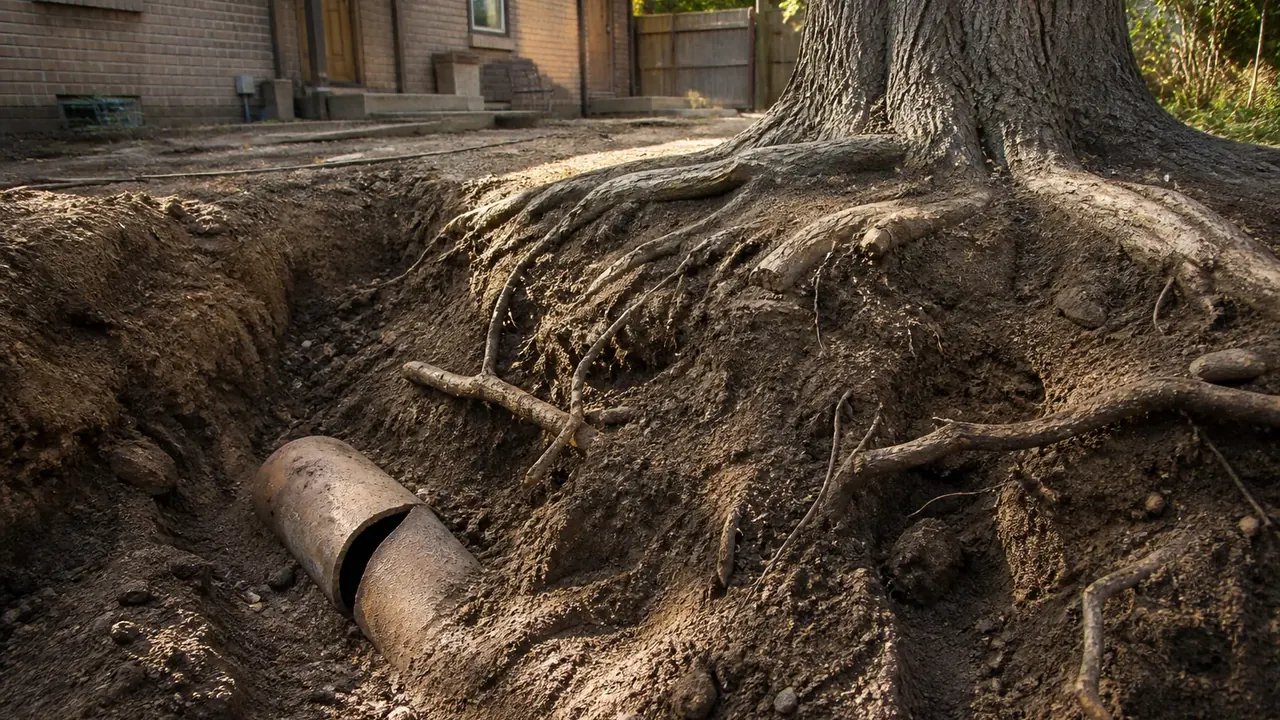
If your main line clog comes back every March like clockwork, roots in a clay lateral are the likeliest explanation, especially in Denver neighborhoods built before 1960. The pattern is so common that drain specialists here plan capacity around root season. See how Denver Drain Cleaners frames recurring clogs as a main-line problem, not a sink snake job.
How clay laterals fail
Vitrified clay pipe was the standard sewer lateral for decades. Each section joins the next at a hub-and-spigot joint. Those joints are not perfectly watertight forever. As soil shifts and joints age, tiny gaps open. Tree roots do not randomly explore soil, they grow toward moisture and nutrients. A leaking joint is both.
Denver's street trees, Siberian elms in particular, are notorious. A root the diameter of a pencil can enter a joint and expand inside the pipe until flow is restricted. By the time you notice a slow main drain, the root mass may already be substantial.
Why spring is root season
As soil warms and trees exit dormancy, root growth accelerates. A drain that quietly slowed through winter often fails completely in March or April. Late-spring runoff can add pressure: saturated ground shifts laterals slightly and groundwater may enter cracked pipes, changing how the line behaves.
That seasonal timing is useful. If your clog history maps to spring three years running, tell whoever you call, it narrows diagnosis fast.
Clearing vs. fixing
Root cutting with a main-line cable and appropriate cutting head opens the pipe temporarily. It is not a permanent repair, roots regrow. Some homeowners schedule preventive cleaning on a cycle if removal is not yet justified. Others need camera confirmation to see how much pipe is damaged before deciding on repair options.
Specialists who do rooter and main-line clearing daily carry machines sized for 4-inch laterals, which matters because a drum machine built for a kitchen branch will not cut roots 75 feet from the house.
What you can and cannot do yourself
Hardware-store snakes rarely reach a main lateral cleanout depth, and cutting roots without knowing pipe condition risks damaging fragile clay or Orangeburg downstream. Document your symptom history, dates, weather, which fixtures, and save DIY effort for single-fixture clogs instead.
Buying or owning an older Denver home
Sellers rarely advertise lateral condition. If you are purchasing in an elm-lined block, a sewer scope before closing is cheap compared to surprise main-line work in year one. Even if you already own the home, knowing you are on clay with root history sets expectations for maintenance rather than emergency-only calls.